How YouTube Was Ruined
The Death of the Bedroom Creator
YouTube used to be a wonderfully chaotic corner of the internet.
It was built on random, goofy, deeply personal content. You uploaded because you had a weird hobby, a goofy sense of humor, or a specific topic you cared about so much that you just wanted to share it with whoever might stumble across it. The algorithm didn’t dictate your existence; like-minded people simply found each other. You hit record on whatever crusty webcam you had plugged into your computer, talked to the camera, and called it a day.
Fast forward to today, and YouTube has turned into corporate slop—a giant money-making machine where everything is engineered for clicks and watch time, and almost nothing is about raw creativity.
Content creation doesn’t look like someone hanging out in their bedroom anymore; it looks like a mini Hollywood movie. Just to get your foot in the door, it feels like you need high-end cameras, professional lighting, studio gear, and industry contacts to help you out. Every big creator seems to have an entire team behind them: writers, producers, thumbnail designers, audio engineers, and full-time editors.
I came across this Reddit comment that Felix made 13 years ago, and I still fuck with it heavily:
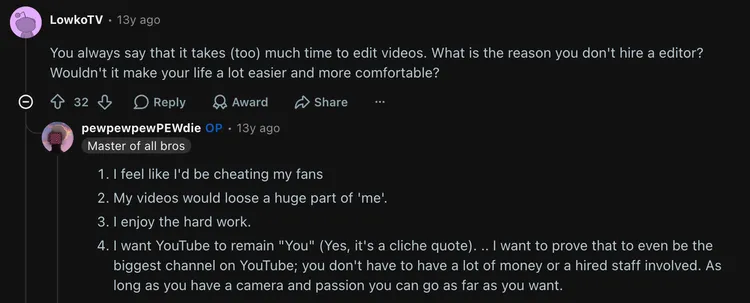
PewDiePie replying on Reddit 13 years ago. “I want YouTube to remain ‘You’.”
Now, I know Felix did eventually hire an editor later on, and bringing up this screenshot might feel almost hypocritical at first glance. But there’s a big difference between bringing on an editor like Brad or Sive to mess around and riff on inside jokes, versus turning your channel into a corporate factory line. For PewDiePie, the editing highlighted his personality; it didn’t replace him. What he said in that Reddit comment still hits hard:
“I want YouTube to remain ‘You’… I want to prove that to even be the biggest channel on YouTube; you don’t have to have a lot of money or a hired staff involved. As long as you have a camera and passion you can go as far as you want.”
Compare that mindset to what we have now. Wherever you look, it’s the exact same video format. It’s either AI-generated slop pumped out for quick cash, or MrBeast-style videos where people blow crazy amounts of money just to make an eight-minute video.
The Great Irony: How MrBeast Became T-Series
I still remember the biggest moment on the platform: PewDiePie vs. T-Series back in 2018–2019.
Back then, the storyline felt huge. The whole internet rallied together around one idea: an individual creator, making videos from his bedroom, standing his ground against a massive corporate giant.
And remember who was leading that campaign on the ground? MrBeast.
He was buying billboards, running ads on radio stations, and pulling stunts at the Super Bowl. He campaigned because he wanted to see a solo creator win. Everyone was chanting the same thing: we don’t want corporate companies turning YouTube into TV; we want YouTube to stay for creators.
Yet look at where things ended up just a few years later.
MrBeast didn’t just beat T-Series—he basically became what T-Series was. He built a massive production company with millions of dollars, business executives, writers’ rooms, data analysts, and animators, turning YouTube into something closer to television or Hollywood.
The difference between these two eras is wild:
- The PewDiePie Era was messy, random, and human. Felix could sit in his chair, scream at a buggy game, or laugh at dumb memes, and millions of people tuned in simply because they liked him. The videos didn’t need to be perfect because people were watching for the person behind the screen.
- The MrBeast Era is super cinematic and hyper-optimized. The thumbnail, the crazy hook in the first three seconds, the breathless pacing, the fake hype—almost every second is designed to trap your attention so you don’t scroll away.
At some point, it stops feeling like YouTube and starts feeling like cable television. And that’s the irony: the guy who once fought to protect indie creators helped create a standard that regular creators can’t even afford to compete with.
The Retention Trap and the Anticlimax
Have you noticed how difficult it has become to just find a good YouTube video to watch while you’re eating alone?
You sit down with a hot plate of food, open the app, and scroll endlessly. By the time you finally pick something, your food is already getting cold—and the video you settled on turns out to be just loud, exhausting noise.
Every video starts with an explosive, high-stakes hook designed to grab you immediately. There’s fake urgency, countdown timers, dramatic music, and creators yelling at the camera like your life depends on watching until the end.
You click because you’re actually interested. But as the video plays out, the actual point of the video feels paper-thin. By the time you get to the big reveal, it’s completely underwhelming and anticlimactic. You’re just left sitting there with an empty plate, feeling disappointed.
When videos are made just to game the algorithm instead of telling a good story, the ending is always a letdown. You aren’t watching someone share their passion; you’re watching a video designed purely to keep you hooked for ad money.
Marshall McLuhan and Cognitive Atrophy
This isn’t just an issue with YouTube, though. It’s part of a bigger change in how we use technology.
Some people can’t walk around a city without an app telling them where to turn. Some people can’t write a simple two-paragraph email without using AI to draft it first.
The Canadian philosopher Marshall McLuhan once pointed out that our technologies both extend and amputate us:
“Every extension is also an amputation.”
The wheel let us travel farther than our feet ever could, but it made our feet go soft. We moved faster, but we lost our natural endurance.
The same thing happens to our brains. It’s called cognitive atrophy: the idea that the less you use a certain brain function, the worse you get at it, and eventually you might stop being able to do it altogether.
- If you stop playing guitar, your fingers slow down and you lose your touch.
- If you stop reading challenging books, your vocabulary and your ability to express yourself narrow down.
- If you stop focusing on anything for long periods of time, your attention span shrivels.
Of course, this isn’t always a bad thing. The brain is an efficient organ—it drops what it doesn’t need so it can focus on what it does. Few people reading this will ever need to start a fire without a lighter, and that’s completely fine.
But with AI being plugged into everything we do, the question becomes much more important:
What brain processes are we willing to give up?
Would you be okay giving up the ability to search multiple sources, dig through information, and write a clear thought on your own? Are you okay giving up the ability to make art and express your own views the way you want to?
The problem isn’t that our brains adapt—they will always grow or shrink based on what we do. The real question is: what do we actually want to do with our brains? What do we want our inner life and experiences to feel like?
The Internet Accidentally Killed the Local Legend
And that brings me to what might be the saddest part of the modern internet: it accidentally killed the local legend.
Think about how towns used to be. In every town, there used to be a local legend:
- There was a guy who was unbelievably funny at every party.
- There was a girl who everyone in town thought was gorgeous.
- There was someone who played the guitar so well that people would literally walk over just to hear him play on his porch.
The cool thing was, they didn’t have to be the best in the world. They didn’t have to be Jimi Hendrix or a world-famous comic. They just had to be the best anyone around had ever seen. That was enough to make them feel special and give the community something to rally around.
Today, that whole feeling is gone.
The funniest guy you know is directly competing with every professional comedian on your phone screen. The prettiest girl in your town is compared to models flown across the world on Instagram. The local guitarist doesn’t feel special anymore because an eleven-year-old on TikTok just played an impossible solo with zero mistakes.
You can be incredibly talented nowadays and still feel completely ordinary, because our reference point used to be the two hundred people around us. Now, our reference point is the entire planet.
And I wonder if that’s why so many people never feel like they’re exceptional anymore.
People didn’t become less interesting, less funny, or less gifted.
Maybe interesting just became impossibly expensive.
Reclaiming the Messy and the Human
When every video has to be a million-dollar movie, when every paragraph has to be rewritten by an AI, and when every talent has to beat the entire planet just to feel worthwhile, everything starts to feel hollow and boring.
We trade real human connection for watch-time graphs. We trade our own thinking for algorithmic convenience. And we trade the charm of the local legend for feeling mediocre next to an infinite feed.
I miss the days when people made videos because they were excited, not because a retention graph told them to. I miss reading someone’s clumsy, honest writing rather than clean, soulless AI text.
Maybe the fix isn’t trying to out-budget MrBeast or write the perfect AI prompt. Maybe it’s just having the courage to make things that are raw, low-tech, and human again—and being completely fine with being a local legend in our own corner of the world.
A Necessary Postscript on Hypocrisy
And yes—the irony is not lost on me that after writing an entire essay warning about cognitive atrophy and the dangers of handing over human expression to machines, I used an AI to help me organize and edit these very thoughts.
It proves just how easy it is to let the tools take over. It’s so tempting to hand off the hard work of drafting and polishing because it saves time. But that effort is where the human part actually lives.
The machine can give me back clean paragraphs, but it couldn’t give me the memory of sitting in front of a computer watching bedroom creators, or the quiet sadness of watching the local legend disappear. The observations were mine; the friction was outsourced. And moving forward, maybe that friction is the exact thing we all need to fight to keep.
(For full radical transparency and proof of provenance, you can view my unedited raw notes & initial brain dump—with every typo, tangent, and unfiltered thought intact).